Believe me when I say, I know from first hand experience that applying for an Education, Health and Care Plan (EHCP) can feel overwhelming for both families and schools. Many parents, including myself, go into the process already expecting a fight, while SENCOs often feel under pressure trying to balance evidence gathering, Local Authority expectations, and limited resources.
One of the most common questions we hear is:
“How can we reduce the chances of push back from the Local Authority?”
The reality is that no application can guarantee approval. However, after years of supporting families with their applications, we are seeing clear patterns in the applications that progress more smoothly — and they almost always come down to the quality, clarity, and consistency of the evidence provided.
So we decided that this week’s blog would share practical tips for both parents and SENCOs on how to strengthen EHCP applications and reduce unnecessary delays, challenges, and refusals.
Focus on Impact — Not Just Diagnosis
An EHCP is not allocated because a child has a diagnosis. Its so much more complex than that. An EHCP will only be allocated because their needs require provision that is additional to or different from, what is normally available in school.
This is where the problems of push back can start. If we dont provide evidence that clearly explains…
- how the child’s difficulties affect education,
- what barriers exist,
- and why ordinarily available provision is not enough.
We will always be refused!
Instead, explain the impact and make it quantifiable.
For example:
😞 “Archie is autistic and struggles socially.”
😊 “Archie is unable to independently access unstructured social times, resulting in daily incidents of dysregulation, withdrawal, and missed learning following break times.”
This is clear and the impact is more measurable therefore producing a much stronger case.
Use Quantifiable Evidence Wherever Possible
Strong EHCP applications are ALWAYS measurable.
Local Authorities are more likely to push back if you use vague wording like “often struggles”, “finds it difficult” “needs support regularly” etc. We need to be assured in our requests
Instead, quantify the need:
- “requires adult prompting 12–15 times per lesson”
- “working 4 years below age expectations in reading”
- “school refusal occurring 2–3 times weekly”
- “requires 30 minutes of emotional regulation support daily”
This kind of measurable data creates evidence that is ( in our experience) way harder to dispute.
Show What Has Already Been Tried And Its Impact
One of the biggest reasons for push back is when an application does not demonstrate graduated response. Schools SHOULD clearly evidence the interventions already implemented, how long they were in place for, the level of support provided and the outcome of it all.
You would be amazed at the number of SENcos that miss this AND ITS NOT always their fault. They maybe new to the job, dont have enough allocated time or support from SLT etc. However, it then impacts the needs of the child and so I share this not to criticise but to support!
Parents can help by documenting bits to give to the SENco to support them with evidence. Because the key question the Local Authority often asks is:
“What has already been tried, and why is this not enough?”
And when they dont get a definitive answer to this, push back the becomes alot more likely.
The goal is not to “fight harder.” The goal is to build a clear, evidence-based picture that demonstrates why the child or young person cannot have their needs met through ordinarily available provision alone. How can that be successfully argued against?!
EHCP Evidence Gathering: Using the “So What?” Method
This is one of my favorite little golden nuggets of joy beause its SO handy!
When gathering evidence for an Education, Health and Care Plan (EHCP), one of the biggest mistakes people make is describing a child’s difficulties without explaining the impact those difficulties actually have on daily life and education.
This is where the “So What?” method becomes incredibly powerful.
The purpose of EHCP evidence is not just to list needs — it is to clearly show why support is necessary and what happens when support is not in place.
What Is the “So What?” Method?
The “So What?” method means asking:
- So what does this difficulty stop the child from doing?
- So what impact does this have on learning, friendships, emotional wellbeing, independence, or safety?
- So what support is needed because of this?
In short, instead of simply stating a need, you explain the measurable impact of that need.
For example:
😞 “Archie struggles with transitions.”
This tells us there is a difficulty — but not why it matters or how it impacts him or the class. This is saying the same thing but its much harder to argue with…
😊“Archie struggles with transitions between lessons, resulting in distress behaviours 3–4 times per day and requiring 15 minutes of adult support to regulate before learning can continue.”
Now the impact is clear, measurable, and much harder to dismiss. So often the evidence IS there, its just not documented correctly…believe me, I KNOW how annoying that is!!!
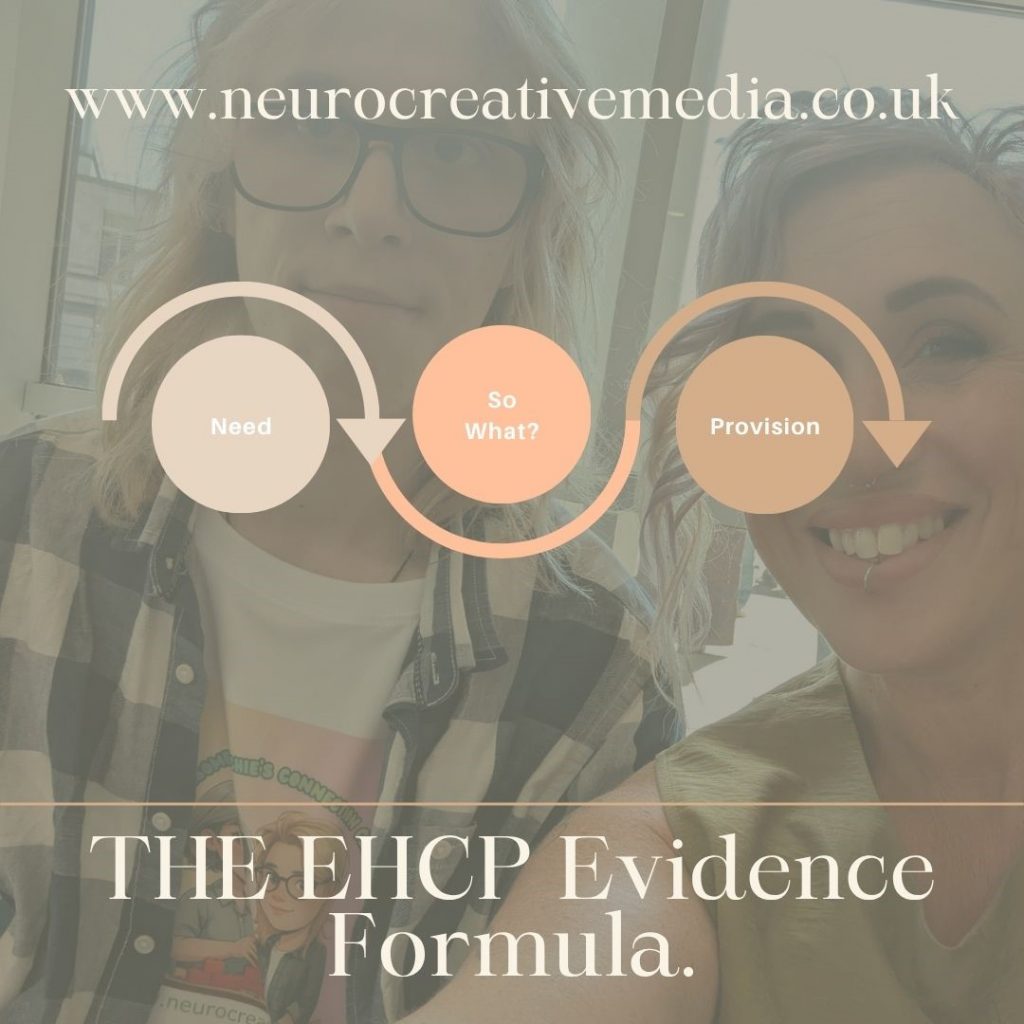
A useful formula to remeber is:
Need → So What? → Provision
For example:
“Without visual supports and adult preparation for transitions, Archie becomes overwhelmed, leading to class refusal on average 3 times per week. He requires a structured visual timetable and consistent adult support during transitions.”
This helps show why support is necessary and that it’s not optional.
Our Awesome Tip
If you are writing EHCP evidence, always ask yourself:
“If someone reading this knew nothing about my child, would they understand exactly how this difficulty affects their access to education and daily life?”
If the answer is no, keep asking “So what?” Because in our opinion, that is often where the strongest evidence is found.